Table of contents
Copycat Infrastructure Attacks: When Fraudsters Impersonate Internet Providers and Why It Matters
Fraudsters increasingly impersonate internet infrastructure providers by copying identity, paperwork, and IP claims. This article explains how copycat attacks work, how to verify IP ownership, and why consistent trust signals matter for the entire ecosystem.

Quick Learnings:
- “Copycat” incidents often rely on identity tricks (lookalike domains, emails, documents) more than real technical control.
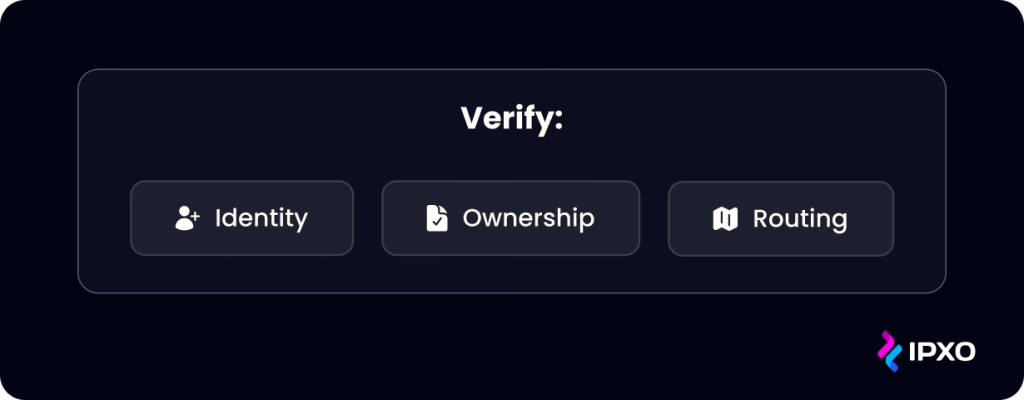
- The fastest way to cut through claims is to verify in three layers: RIR/WHOIS → RPKI/ROAs → BGP reality.
- The biggest risks are usually payment fraud, operational disruption, and reputational damage – even without any routing attack.
- Well-known infrastructure brands are attractive targets because their names reduce skepticism and speed up decisions.
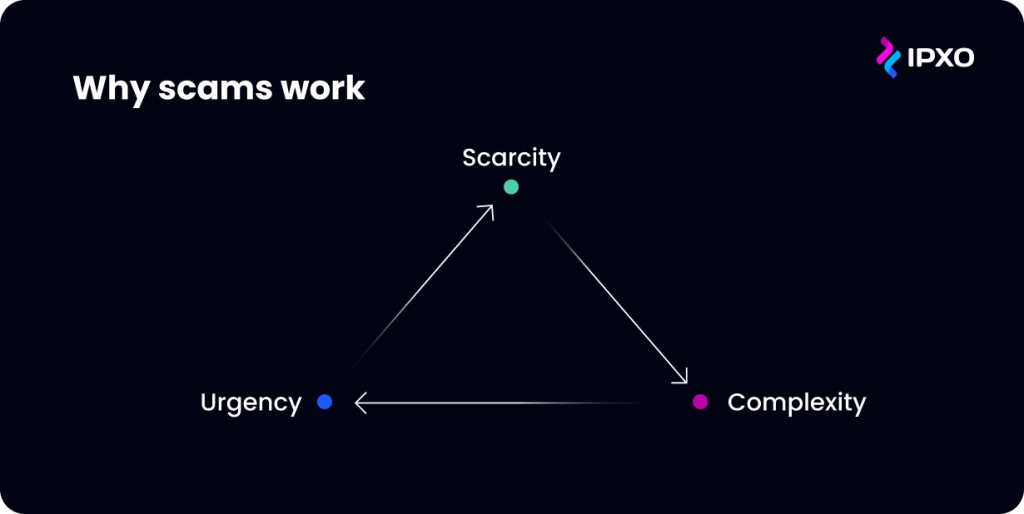
- IPv4 scarcity and urgent timelines can make teams skip verification, which is exactly what impostors exploit.
- The market response is trending toward higher verification standards and less tolerance for informal, unverified deals.
- The most effective defense is procedural: clear identity confirmation, strict payment-change rules, and repeatable verification steps.
Impersonation scams aren’t new, but when they target internet infrastructure providers, the impact can go beyond a single bad deal. The internet runs on trust signals – registry data, routing authorization, operational reputation, and identifiable points of contact. A convincing copycat can exploit gaps in those signals to redirect payments, confuse customers, or create operational noise that drains real teams of time and focus.
In the past year, the industry has seen more cases where fraudsters pose as legitimate providers or IP resource platforms, using lookalike domains, copied documents, and misrepresented IP ranges to appear credible. Some incidents are pure social engineering; others come with more technical claims about “ownership” or “control” of certain prefixes. Either way, the goal is the same: use a trusted name to lower the victim’s guard.
This post breaks down what “copycat IP range” impersonation usually looks like, how to verify whether a Regional Internet Registry (RIR) really allocated the ranges being claimed, why recognizable organizations are attractive targets, and what this trend means for the broader market.
What “copycat IP ranges” actually means
The phrase “copycat IP ranges” can be misleading. In many cases, attackers don’t control any IP space at all – they borrow legitimacy through partial truths, screenshots, and social pressure. What they are really copying is trust: the brand, the tone, the paperwork, and sometimes the appearance of technical authority.
Impersonation typically appears in three overlapping forms. First, brand impersonation – lookalike domains, email addresses, and signature blocks that match the real organization closely. Second, commercial impersonation – offering leases or transfers “on behalf of” a company, often with urgent timelines or unusually good pricing. Third, technical impersonation – claims that they “own,” “manage,” or can “assign” specific prefixes, often supported by cherry-picked registry text or routing screenshots.
The important point is that many victims don’t know what to check, and even those who do may skip verification when they’re under pressure – especially in a market where address scarcity and lead times can feel urgent.
Quick verification: Did the RIR allocate those ranges to the real company?
This is the first question to answer, and it’s usually verifiable with public signals – if you have the suspected prefixes. A reliable approach is to treat screenshots and forwarded “proof” as untrusted, and only rely on sources that are hard to fake.
Use this high-signal verification flow:
- Registry reality (RIR/WHOIS): confirm the authoritative registry and the registered org/maintainers for the prefix.
- Routing authorization (RPKI/ROAs): check whether the origin AS is authorized to announce the prefix.
- Routing reality (BGP): confirm who is actually originating the route in the global routing table.
When these three don’t align, it’s a red flag. Even when they do, counterparty identity still matters – attackers can claim association with a legitimate prefix while routing payments and comms through their own channels.
If you’re writing publicly about a specific incident, it’s also worth being careful with wording. There’s a difference between “a range was claimed” and “a range was allocated to us by an RIR.” The first is a reported claim; the second is a verifiable fact.
Why this can become a serious business risk (not just “another scam”)
In the IP ecosystem, impersonation isn’t only about tricking someone into a bad deal. It can create knock-on effects across operations and reputation, especially when teams are moving quickly due to scarcity or deadlines.
Typical consequences include:
- Payment fraud and disputes: invoices, bank details, and contract routing get manipulated – often discovered only after funds move.
- Operational disruption: false abuse reports or “urgent” instructions that pull engineering time away from real work.
- Reputation fallout: victims associate fraud attempts with the brand being impersonated, even when the brand wasn’t involved.
- Routing-level risk (less common, higher impact): unauthorized announcements or route leaks that can create instability or misdirection.
The common thread is trust. Once doubt enters the process, every next step costs more time and verification, and the overall market becomes less efficient.
Why well-known targets are targeted
Fraudsters tend to select names that make the scam easier. If a brand is recognizable in connectivity, more people will accept the premise that “yes, they can source address space” or “yes, they can approve this request.” That brand familiarity lowers skepticism and speeds up the decision cycle – which is exactly what attackers want.
There are also practical reasons. Providers and platforms that sit close to the critical path of connectivity often interact with many counterparties: holders, lessees, brokers, ISPs, hosting providers, and enterprise network teams. More counterparties means more chances for an attacker to find someone who hasn’t seen the pattern yet.
It’s tempting to over-explain motive – especially with large brands – but in many cases it’s not political. It’s opportunistic. Scarcity, transaction complexity, and urgent timelines create ideal conditions for impersonation to work.
Broader implications for the market
Incidents like this rarely change demand. What they do change is tolerance for informal deals and weak verification. Over time, the market shifts toward a higher baseline: “If you can’t prove control and identity quickly, the deal slows down.”
That shift is healthy, but it also raises the cost of operating for legitimate participants who still rely on manual workflows. The more the ecosystem depends on email threads, PDFs, and disconnected verification, the easier it is for copycats to insert themselves.
The long-term direction is clear: stronger verification norms, more standardized transparency, and more reliance on systems that make fraud harder to scale.
What actions are typically taken in response
When impersonation is detected, the most effective responses reduce ambiguity for everyone involved. Internally, that often starts with tightening identity controls (domain security, official comms channels, escalation paths). Externally, it includes warnings to customers and partners, reporting impersonation channels, and coordinating takedowns where possible.
What matters most is making verification simpler than deception. If a customer can confirm legitimacy in under a minute – through validated contact points, registry consistency, and routing authorization – copycat attempts lose their leverage.
What organizations can do right now
The best defense is routine verification plus clear internal rules. If your finance and network teams follow the same checklist – and can escalate quickly – impersonation becomes a minor inconvenience instead of a serious incident.
Even a few basic habits make a difference: validating counterparty identity through known channels, treating bank detail changes as high-risk events, and requiring verification for any claim of IP control or assignment ability.
Closing: trust is part of infrastructure
Internet infrastructure relies on more than equipment and protocol specs. It relies on shared trust that identity claims can be verified and that “ownership” means something concrete in registries and routing policy.
Copycat attacks don’t succeed because the internet is fragile. They succeed because humans are busy, markets are pressured, and verification is often inconsistent. The industry response should be equally practical: make verification routine, fast, and hard to fake.
FAQ
A copycat infrastructure attack is a form of impersonation where fraudsters pose as a legitimate internet provider, IP platform, or broker. They copy branding, communication style, and sometimes technical claims to appear credible and gain trust.
About the author

Indre Ceberkaite
Related reading

Still Using Traditional Broadband? Here’s Why Fiber Internet Is a Smarter Move
Have you ever noticed your internet slowing down exactly when you need it the most – during a video call, while streaming, or when uploading…
Read more
How Internet Infrastructure Shapes the Future of Remote Work
Internet infrastructure shapes the future of remote work by influencing performance, reliability, and access. This post examines how factors like fiber availability, IPv4 limits, and home network security impact…
Read more
Is open source dead? Rethinking the model in the age of AI
Open source remains a critical part of modern software development, but its role is changing. As AI lowers the barriers to building and running software, companies need to rethink…
Read more
Subscribe to the IPXO email and don’t miss any news!