Table of contents
IPv4 Lease Price Trends & Predictions for 2025
IPv4 lease prices stayed steady through 2024, even as purchase markets swung sharply by block size. In 2025, leasing continues to act like a predictable utility at $0.40/IP with 80% utilization, while /16 purchase prices have fallen to their lowest point in years. This blog unpacks what the trends mean for operators planning ahead and offers forecasts for 2026.

The IPv4 market went through another year of transition in 2025. In 2024, leasing prices stayed stable while purchase prices swung widely, particularly for large blocks. Now in 2025, the story continues. Lease rates remain steady at around $0.40/IP with strong utilization, even as purchase prices for /16s dropped below $20/IP for the first time since 2019. For operators, cloud providers, and enterprises, this divergence underscores an important shift: leasing is behaving more like a utility with predictable OPEX, while purchases remain capital-intensive bets.
Quick Learnings:
- 2024 recap: Lease prices averaged $0.50/IP across RIRs; leasing stayed stable while purchase prices, especially large /16s, moved sharply.
- 2025 snapshot: The last-90-day average lease price on IPXO sits at $0.40/IP with utilization ~80%, signaling a healthy, liquid market.
- Purchase market: /16 purchase prices fell below $20/IP by mid-2025, the lowest since 2019, underscoring ongoing volatility on the buy side.
- Operational quality: 97.66% of abuse cases on IPXO are handled automatically – one driver of leasing price stability and consistent reputation quality.
Brief Recap of 2024 IPv4 Lease Price Trends
Through 2024, IPv4 leasing held steady at about $0.50/IP per month, even as purchase prices diverged by block size. Large blocks (like /16) corrected notably while smaller blocks (/20–/24) remained comparatively firm. That spread reflected shifting enterprise behavior and the resilience of subscription-like leasing in turbulent conditions.
The result: by year-end 2024, the lease market looked boring, but in a good way. Predictable pricing, steady take-up, and platform-level quality controls supported consistent utilization and reduced downside risk versus outright purchase.
How IPv4 Pricing Changed in 2025 So Far (Q1–Q3)
Prices eased, utilization stayed strong. In 2025, the IPXO platform’s last-90-day average is $0.40/IP, with 80%+ utilization. Meaning, demand hasn’t evaporated – buyers are simply more price-sensitive, and supply is being matched more efficiently via marketplaces.
Purchase volatility continued. The headline datapoint: /16s dipped below $20/IP in June 2025 – the first time since 2019. For CFOs, that’s a clear reminder that purchasing IPv4 remains a timing-sensitive, capex-heavy bet, especially in large blocks.
Macro demand drivers persisted. AI data collection, cloud expansion, and IoT workloads continue to need routable IPv4 at the edge and within hybrid architectures. Meanwhile, global IPv6 adoption keeps advancing, but not fast enough to relieve near-term IPv4 demand across all regions and use cases.
How IPv4 Lease Pricing Varies by RIR Region
IPXO’s live dashboard remains the best pulse-check for leasing levels across RIRs. Current platform-wide averages sit at $0.40/IP (last 90 days), with utilization ~80%. Regional spreads continue to reflect policy, scarcity, and demand dynamics:
- APNIC (Asia-Pacific): Lease prices can be higher when supply is tight. APNIC policies have historically limited broad monetization (except legacy), which can reduce available supply and props up lease rates.
- RIPE NCC (Europe, the Middle East, and parts of Central Asia): Deep, liquid supply and active monetization often keep pricing orderly; traditionally anchors global averages on platforms like IPXO. (Use IPXO Market Stats for weekly deltas.)
- ARIN (United States, Canada, and parts of the Caribbean and North Atlantic): Strong infrastructure demand and active market participation make ARIN one of the key regions influencing global IPv4 lease pricing.
- LACNIC (Latin America and parts of the Caribbean): Pricing can vary based on local demand, geolocation needs, regional infrastructure growth, and available supply.
- AFRINIC (Africa): Competitive pricing with pockets of variance tied to local policy, geolocation needs, and sector-specific demand.

Factors That Shaped IPv4 Lease Pricing in 2025
Policy gating & RIR nuance. Where leasing is constrained or administratively discouraged, price premia persist because holders are less willing/able to monetize directly. APNIC’s stance (e.g., addresses tied to connectivity services, limited leasing structures) is the classic example affecting supply dynamics.
IPv6 progress, but not parity. Annual IPv6 growth continues; however, most organizations still require dual-stack or IPv4 reachability for customers, third-party integrations, and email deliverability, supporting ongoing IPv4 leasing demand into 2026.
Abuse automation & reputation quality. A clean marketplace matters. IPXO’s automation handles ~98% of abuse cases, and the incident mix (spam, brute force, DMCA, etc.) is published with shares by type. Better automated remediation → fewer sustained blacklist events → more stable lease pricing.
Block-size strategies. On the buy side, 2025 shows the widest divergence between large blocks (/16 and bigger) and mid/smaller blocks (/17–/24). That divergence encourages enterprises to lease tactically (right-sizing by region and project) instead of buying at scale and carrying depreciation risk.
What should businesses expect from IPv4 lease pricing in 2026?
In 2026, businesses should expect IPv4 lease pricing to remain more predictable than IPv4 purchase pricing, but not identical across regions. Lease prices will continue to depend on RIR region, subnet size, IP reputation, utilization, geolocation needs, and market demand. Operators should use current marketplace data rather than fixed historical benchmarks when planning IPv4 capacity.
- Leasing: Expect continued price stability near current levels with mild upward drift in regions where policy suppresses monetization (e.g., parts of APNIC). Liquidity and utilization on platforms like IPXO should remain robust if abuse automation keeps incident impacts low.
- Buying: Price dispersion likely persists. If /16 supply stays elevated, large-block prices could remain soft or range-bound even if smaller blocks stabilize or firm.
Price Predictions for 2026 and Beyond
Looking ahead, IPv4 leasing prices are likely to remain resilient despite fluctuations in the purchase market. Based on IPXO Market Stats and global RIR policy trends, here’s what to expect:
- Steady global averages with regional premiums – Leasing rates should hover between $0.38 and $0.45/IP for most of 2026, with APNIC maintaining a premium above $0.60/IP in scarcity-driven months.
- Policy-driven volatility in certain markets – Any relaxation of leasing restrictions (particularly in APNIC) could ease regional premiums, while tighter policies elsewhere could cause localized price spikes.
- Small-block demand holding firm – /24–/22 subnets will likely see the most stable lease pricing due to their flexibility in geotargeting, compliance, and operational right-sizing.
- Impact of AI and IoT – As AI workloads and IoT deployments scale, demand for routable IPv4 space at the network edge will keep utilization above 80% on platforms like IPXO.
- Gradual upward pressure from IPv6’s slow rollout – Until IPv6 adoption reaches critical mass (well beyond the current 40% global average), IPv4 leasing will remain a strategic necessity for most operators.
For operators, this means 2026 is unlikely to bring sudden cost relief, but it does offer a predictable, stable leasing environment for those who plan capacity proactively.
Conclusion
The 2025 IPv4 market is characterized by stable leasing prices, healthy utilization, and continued buy-side volatility in larger blocks. Operators that prioritize flexibility, clean IP reputation, and predictable OPEX will continue to favor leasing, especially when they can see the market in real time and right-size by region and term.
Treat IPv4 as an operational utility rather than a speculative asset. Lease what you need, where you need it, for as long as you need it, and then adjust. That’s how you protect service quality, control costs, and move faster than the market.
FAQ about IPv4 lease price trends
Leasing operates like a subscription model, with predictable monthly costs and flexible terms. Purchase prices, by contrast, fluctuate based on block size, scarcity, and speculation. This makes leasing less volatile and easier to budget for.
About the author

Indre Ceberkaite
Related reading
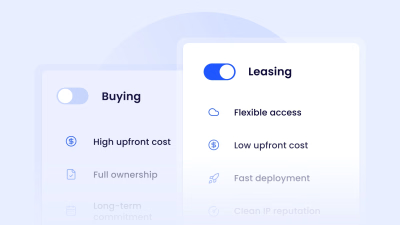
The hybrid IPv4 strategy: When to lease and when to buy
A practical guide to navigating IPv4 scarcity in 2026. Learn when to lease, when to buy, and how a hybrid IPv4 strategy helps organizations balance cost, flexibility, and long-term…
Read more
IPv4 Buying and Leasing in 2026: A Market Recalibration
The year began with a clear signal: the IPv4 market is adjusting. Find out what's happening and what the market will look like moving on.
Read more
BEAD Network Expansion Will Drive IPv4 Demand – Why Leasing Makes Strategic Sense for ISPs
The Broadband Equity, Access, and Deployment Program represents a $42.45 billion investment in expanding broadband infrastructure across the United States. For many operators, the immediate…
Read more
Subscribe to the IPXO email and don’t miss any news!