Table of contents
National Internet Registries: gatekeeper or enabler?
A data-led look at CNNIC, IRINN, JPNIC, and the rest of the world's national IP address registries, what they were built to do, and where they now stand between a country and its own growth.

India connects more than 950 million people to the internet. To do so, the country holds roughly 41.6 million IPv4 addresses. That is about 29 addresses for every thousand residents. The United States, with less than a quarter of India’s population, has around 1.6 billion IPv4 addresses, close to 4,700 per thousand people (publicly compiled allocation data, February 2026). The global average is about 0.45 addresses per person (APNIC, January 2026). India sits far below it. The United States is roughly ten times above.
That gap is not an accident of demand. It is an accident of timing. The countries that wired up first claimed address space when it was free and plentiful. The ones that arrived later inherited a near-empty cupboard, and many built a national institution to manage the little they had and to represent the country in the global address system. That institution is the National Internet Registry, or NIR. China has CNNIC. India has IRINN. Japan has JPNIC. Korea, Taiwan, Vietnam, Indonesia, Brazil, and Mexico each have their own.
The NIR was meant to put a country in charge of its own number resources. Sometimes it has, and done it well. Elsewhere it has become the reason address space cannot move to where growth needs it, the reason some registries offer no route to sell an unused block, and the reason an Indonesian network cannot fully trust the registry it depends on. The institution built to give a country control has, in places, become the thing slowing it down.
And the gap will not close on its own. The United Nations projects India’s population to peak near 1.70 billion around 2062 before declining (UN World Population Prospects, 2024). If its IPv4 holdings stay flat, India’s ratio slips from 29 toward roughly 24 per thousand even as the United States stays above 4,000. Demand climbs, the fixed pool does not, and waiting changes none of the arithmetic. Two levers can shift it. IPv6, the abundant successor protocol, is one, though its rollout is wildly uneven: India has already passed 75 percent adoption while Indonesia and South Korea sit below 30, so it is no universal fix and will not arrive on schedule everywhere. The lever that works in every market today is moving idle IPv4 to the networks that need it.
This is the tension worth examining honestly. The claim here is not that NIRs are bad; the data does not support that, and anyone who works in the field knows it. The claim is narrower and more useful. It is not the existence of an NIR that holds a country back. It is the posture some of them adopt. A registry can be a gatekeeper or an enabler, and the difference shows up in the numbers.
Quick learnings:
- The world has nine National Internet Registries, all under APNIC and LACNIC. No other region uses the model, and the door to new ones is now closed.
- Whether a country has an NIR does not predict its digital outcomes. India leads the world on IPv6 with one; Hong Kong sits last without one.
- The binding constraint is IPv4 scarcity, not the registry. The damage comes from a gatekeeper posture: closed transfers, opaque records, and mandatory routing.
- Roughly 587 million IPv4 addresses sit idle worldwide while address-poor economies go without.
- The fix is to turn the control layer into a liquidity layer: open transfers, legitimize leasing, accelerate IPv6, and keep the registry honest. Sovereignty and a working market are not opposites.
What a national Internet Registry actually is
Internet addresses are handed down a chain. At the top sits the Internet Assigned Numbers Authority (IANA), which allocates large blocks to five Regional Internet Registries (RIRs): APNIC for Asia-Pacific, ARIN for North America, RIPE NCC for Europe and the Middle East, LACNIC for Latin America and the Caribbean, and AFRINIC for Africa. Each RIR allocates addresses to networks in its region, typically internet service providers and large enterprises known as Local Internet Registries (LIRs), which assign addresses to end users.
In most of the world the chain is flat: IANA to RIR to LIR. In two regions there is an extra rung. APNIC and LACNIC delegate to National Internet Registries (NIRs), country-level bodies that sub-delegate to members within their borders. No NIRs exist under ARIN, RIPE NCC, or AFRINIC; those regions kept a single regional layer with no national tier.
There are nine NIRs in operation as of 2026:
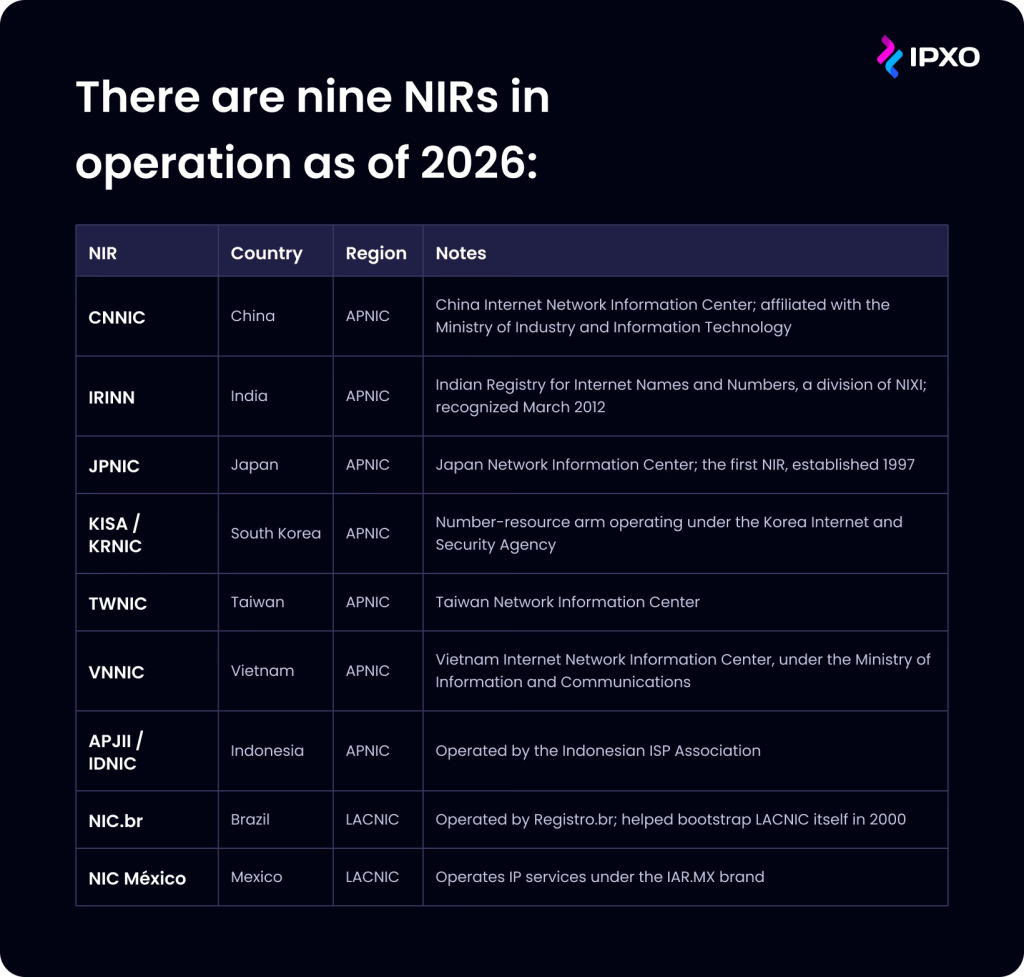
Three features of this structure matter for everything that follows.
NIRs are not run by the RIR above them. They are separate nonprofit entities, incorporated under their own national laws, with their own members and fee schedules (APNIC, 2026). They make delegations in line with the parent RIR’s policy, but they answer to a domestic constituency.
Membership is not always optional. In the APNIC region an organization can choose: join the national NIR, or go directly to APNIC, but not both (APNIC, 2022; IRINN FAQ, 2026). In the LACNIC region the choice is removed: organizations in Brazil and Mexico must request resources through their NIR rather than directly from LACNIC (LACNIC, 2026). That single difference, optional versus mandatory, shapes how much friction the layer can impose.
The system is also closed to newcomers. APNIC placed a moratorium on new NIRs in 2012 and made it permanent in 2024 (APNIC, April 2024). Whatever an NIR is today, no country in the region will add one tomorrow.
The case for them
It would be easy, and wrong, to treat NIRs as bureaucratic dead weight. They exist for reasons that were sound when they were created and remain so today.
Start with language and proximity. APNIC serves dozens of economies across the most linguistically diverse region on earth. A small network in Hanoi or Surabaya, run by engineers who do not work in English, found it far easier to deal with a national body that spoke the local language, understood local registration, and sat in the local time zone. JPNIC, the first NIR, grew out of exactly this logic in 1990s Japan, and others followed. For much of the internet’s expansion, the NIR lowered the barrier to getting online for thousands of organizations a distant regional registry would have left struggling.
There is also a capacity argument. Brazil’s NIC.br did not merely receive addresses from LACNIC; it supplied the staff and infrastructure that let LACNIC begin operating as a regional registry in 2000 (LACNIC, 2000). In several developing economies the national registry became the home for technical training, network operator groups, and measurement work no one else was doing. In practice, the NIR was a piece of national digital infrastructure.
And there is sovereignty, which deserves to be taken seriously rather than waved away. IP address allocation is not neutral plumbing. It decides which organizations can build networks and on what terms. A government that wants a say in that, for national security, industrial policy, or independence from foreign-controlled institutions, has a legitimate interest. The best-run NIRs show what that looks like done well: JPNIC and TWNIC run transparent, efficient registries with published fees and clear transfer procedures, and no one seriously argues they hold Japan or Taiwan back. The institution is not the problem. What it does with its position is.
Sound rationale, though, is not the same as effective delivery, and that is the harder question. Judged against their stated jobs, the NIRs perform unevenly. On local-language onboarding and capacity-building they have a genuine record. On the duties that matter most to a modern address market the picture is weaker: the registration-accuracy failures that APNIC’s audit exposed, the mandatory routing in Brazil and Mexico, and the registries that offer no working transfer path all cut against the case. An institution can be well-intentioned and still underdeliver on the role it was built for. The next section is where that gap shows.
The friction layer
The trouble starts when a national registry uses its position to restrict rather than serve. Here the evidence is specific and uncomfortable.
Some NIRs offer no path for addresses to move. APNIC’s published NIR transfer table shows KISA/KRNIC in South Korea providing no IPv4 transfer service in either direction, and VNNIC in Vietnam offering incoming transfers only (APNIC NIR transfer table, 2026). The table does not say whether this is an outright prohibition or simply the absence of national-level processing, and Korean resources still fall under APNIC’s regional framework. Either way, the effect at the national layer is the same: a member has no straightforward channel to move surplus space out through its own registry. Set that against the picture. South Korea holds roughly 112 million IPv4 addresses, about 2,174 per thousand people, one of the highest densities in Asia (publicly compiled allocation data, February 2026). When the national channel offers no outbound route, that surplus is far harder to bring to the global market where address-poor economies are waiting for it. Multiply it by every holder sitting on space it no longer needs, and national friction becomes a global supply problem.
LACNIC adds friction of a different kind. Addresses may not be transferred for three years after allocation, and a block that has just changed hands cannot be re-transferred for a year (LACNIC Policy Manual, August 2024). Combine the holding periods with mandatory routing through the NIR, and the path from a willing seller to a willing buyer grows longer at every step.
The registry data is not always trustworthy. In late 2023, after an anonymous report, APNIC opened an audit of how its NIRs had been assigning addresses. The early results, published in December 2024, were not reassuring. At IRINN in India, 51 delegations from 2022 were flagged, and 44 were found not to meet policy and recovered. At IDNIC in Indonesia, an audit of 2,974 allocations flagged roughly 1,200 for investigation, and the NIR appointed an independent investigator (APNIC, December 2024). APNIC declared “zero tolerance” for misallocation and committed to auditing every NIR, and itself, across a decade of records. Accurate registration is the foundation of routing security and of the whole address market. When a national layer cannot guarantee it, the cost lands on everyone who relies on the data.
Members trade away their voice. A common assumption is that going through an NIR means paying twice, once to the NIR and once to the RIR. It does not work that way for the seven APNIC NIRs. The NIR is the single APNIC member and pays APNIC’s invoice; its own members pay the NIR instead of APNIC, not in addition (APNIC, 2022). The real cost is subtler. NIR members are not APNIC members, so they have no vote in the regional policy process that ultimately governs their addresses, and they depend entirely on their national registry’s fees and service quality, which vary widely and, for several NIRs including CNNIC, KRNIC, and VNNIC, are not published in a form outsiders can verify. A direct APNIC membership, by contrast, costs a transparent base fee of about 1,295 Australian dollars in 2026, halved for least-developed economies (APNIC, 2026). The NIR route can be cheaper or dearer, but it always means giving up a seat at the table where the rules are written.
Leasing lives in a gray zone. The secondary market has two mechanisms: outright transfer, where the registered holder changes, and leasing, where a holder lets another network use addresses without giving up registration. Leasing is how much idle space is actually put to work, yet its status is unsettled. APNIC’s default guidance treats leasing as acceptable only as part of a genuine connectivity service, and a 2023 attempt to declare it flatly “not acceptable” (prop-148) was abandoned at the APNIC 56 meeting after it failed to reach consensus (APNIC, 2023). CNNIC has long described its allocations as renting rather than ownership and forbids members from transferring or selling without its consent (CNNIC, 2012). The result is a market everyone uses and no one has fully legitimized, which suits incumbents and disadvantages the smaller networks that most need flexible access.
A word on CNNIC, because its name carries baggage that does not all belong here. It wears three separate hats. It is the registry for the .cn domain. It was, years ago, a TLS certificate authority whose roots were distrusted by Google and Mozilla in 2015 after an intermediate certificate was misused for interception (Mozilla, Google, 2015). And it is the National Internet Registry for IP addresses in China. Only the third role is relevant here; the 2015 certificate episode had nothing to do with IP allocation, and using it to indict the registry would be dishonest. The fair criticism of CNNIC as an NIR is narrower: conditional allocations, a restrictive transfer and leasing posture, and policy documents that are hard to verify from outside.
Idle space sits while scarcity bites. IPv4 address exhaustion is not a forecast; it is history. APNIC, the Asia Pacific registry, reached its final block of free addresses on 15 April 2011, the first regional registry to run dry (NRO, 2011). Step back, and the aggregate cost of all this friction becomes visible. Of roughly 3.69 billion IPv4 addresses allocated worldwide, about 3.1 billion are actually announced and routed. The remaining 587 million, around 16 percent of the assigned pool, are allocated but not visible on the internet at all (APNIC, January 2026). Some is operational slack. A large share is simply space holders are not using and have little incentive or ability to release, especially where transfer rules are tight. India, with 29 addresses per thousand people, cannot easily reach dormant blocks held in economies with thirty, fifty, or a hundred times its density. The scarcity is real, but so is the waste sitting next to it.
The sovereignty paradox
None of this means countries are wrong to want control. The desire is genuine and, on its own terms, rational.
For two decades the global address system was overseen, at the top, by an arm of the United States government. That changed on 1 October 2016, when the IANA stewardship transition moved oversight from the US National Telecommunications and Information Administration to the global multistakeholder community, with the number-resource side governed by a service-level agreement between ICANN and the five RIRs signed earlier that year (NRO, ICANN, 2016). It ended a long argument over who should run the internet’s core registries.
That argument never fully settled. At the 2012 World Conference on International Telecommunications in Dubai, a revised telecom treaty split the world: 89 countries signed and 55, including the United States, the United Kingdom, Canada, and Australia, refused (ITU, 2012, corroborated across multiple records). A bloc led by China and Russia pushed for explicit recognition of states’ “sovereign right” to govern their own segment of the internet, against a multistakeholder model in which technical bodies and the private sector share governance.
China has been the clearest voice on the sovereign side. Its 2017 International Strategy of Cooperation on Cyberspace called cyberspace “a new domain of state sovereignty” and argued that “the existing global governance system of basic Internet resources hardly reflects the desires and interests of the majority of countries” (Government of China, March 2017). Russia went further in practice, passing its 2019 sovereign internet law to keep its network running even if cut off from the global domain name system (Human Rights Watch, 2020).
Against this backdrop, a National Internet Registry is the institutional form of a real and defensible wish: that a country, not a foreign body, should administer the number resources its economy runs on. That reading is mine rather than a sourced statement of intent, since the registries describe their work in operational terms, but the alignment is hard to miss. A country that distrusts distant institutions builds its own.
The paradox is that the same instinct, pursued through gatekeeping, produces the opposite of strength. Locking addresses inside the country, slowing their movement, or running an opaque registry does not make the national internet more resilient. It makes it more isolated and less able to draw on the global pool of dormant space when domestic demand spikes. Sovereignty over a resource and the free flow of that resource are not opposites, and the countries that manage both are the ones doing best.
With and without: what the numbers say
The obvious test is to compare economies with an NIR against those without. Singapore, Hong Kong, Australia, and New Zealand sit in the APNIC region and deal with APNIC directly, with no national registry. The United States and Germany work directly with ARIN and RIPE NCC. Set them beside the NIR economies and look for a pattern.
The first thing the data does is destroy a tempting but false story. NIR countries do not lag on the move to modern addressing. IPv6 is the abundant successor to IPv4, and its adoption is a fair proxy for whether a country’s networks are modernizing under pressure. Here is where the economies stood in a June 2026 snapshot from APNIC’s end-user measurement, which samples the share of users who can reach the internet over IPv6 (APNIC, June 2026; a daily-updated snapshot that will shift).


India, an NIR economy, leads the entire group. The two economies at the bottom, Singapore and Hong Kong, have no NIR at all. Whether a country has a national registry tells you almost nothing about whether it has modernized. The variable that does the work is something else.
Scarcity is that variable, at least at one end. Rank the same economies by IPv4 addresses per thousand people and a clear pattern emerges among the address-poor. India at 29, Indonesia at 68, and Vietnam at 164 are short of IPv4 and racing to IPv6 because they have little choice. Among address-rich economies, scarcity explains nothing, because they span the whole range. Germany, at about 1,469 per thousand people, leads the group at 74 percent IPv6, while Singapore, even better supplied, sits at 28. The United States is at 60, South Korea at 29. Where address space is thin, scarcity forces the move; where it is plentiful, operator and policy choices decide. South Korea is the telling case: 2,174 addresses per thousand people, only 29 percent IPv6, and a registry that, per APNIC’s table, offers no transfer path. A well-supplied country with little pressure to modernize and no national channel to release its surplus is one whose comfortable status quo stays in place and whose spare capacity stays off the global market.

Here intellectual honesty has to override a good story. The comparison is full of confounders, and pretending otherwise would be motivated reasoning, especially from anyone with a stake in a freer market. Singapore and Hong Kong are not powerhouses because they lack an NIR. They are financial and connectivity hubs that built world-class exchanges and data centers early, under stable legal systems, which is also why they accumulated so much IPv4 (Singapore at about 4,593 per thousand people, Hong Kong at 1,768). Their low end-user IPv6 reflects a hosting-and-transit role, not a backward consumer internet. Internet penetration is high almost everywhere here, from 98 percent in South Korea to 70 percent in India (World Bank, 2024 to 2025), so the NIR is plainly not gating basic access.
The numbers support a modest, defensible claim. NIR economies span the full range of outcomes, from India’s leadership to Indonesia’s lag, so the registry alone is not destiny. Where an NIR runs an open, transparent, efficient operation, as in Japan and Taiwan, the economy does well. Where it adds restriction and opacity, as with Korea’s missing transfer path or the registration problems at IRINN and IDNIC, it imposes a cost on its own members and the wider system. The harm is not the existence of the layer. It is the friction the layer chooses to add.
Toward a sustainable ecosystem
If the problem is posture rather than structure, the solution does not require abolishing anything. It requires the national layer to act as an enabler. Five changes would do most of the work, and each connects directly to growth.
Harmonize policy with the regional registry. An NIR whose transfer rules, timelines, and documentation match its RIR’s removes the friction of two rulebooks. When a member can move an address out of an NIR economy as easily as out of a direct-APNIC one, the country stops being a dead end on the map of the global market.
Open and standardize transfers. The highest-value reform is to ensure every national registry offers a working IPv4 transfer path in both directions. Where a registry provides no outbound route, as APNIC’s table shows for Korea’s, members cannot release surplus space, capital sits stranded, and growth elsewhere is starved. A clear two-way transfer service, with light pre-approval to confirm legitimate need, lets dormant space flow to where it is wanted. The mechanism already works: across the RIR system, transfers moved about 33 million addresses in 2025, down from a 44 million peak in 2022 (APNIC, January 2026). The market exists. National gates fragment it.
Legitimize leasing. Transfers reallocate ownership permanently, which suits some holders and not others. Leasing is the alternative: a network can lease IPv4 addresses it does not need to another that does, without either side giving up registration, and a transparent IPv4 leasing market could return much of the idle 587 million addresses to circulation. The sensible move is to bring leasing out of the gray zone with clear, registry-backed rules on registration accuracy and routing authorization. A holder that can safely lease has every reason to release capacity rather than hoard it, and a buyer who would rather buy IPv4 addresses outright still can.
Accelerate IPv6. Every reform above buys time; IPv6 ends the underlying scarcity. The NIR economies that pushed hardest, India above all, show that a national registry can drive adoption rather than delay it. Adoption will stay uneven, and some economies will lag for years, which is exactly why IPv6 cannot be the only plan. Pairing an open IPv4 market with an aggressive IPv6 program is how a country eases the short-term squeeze and escapes it in the long term.
Make the registry trustworthy. The APNIC audits are a warning. Accurate records, secured by the Resource Public Key Infrastructure (RPKI), let networks route safely and give buyers confidence that an address is genuinely theirs. Transparency is not a compliance chore. It is the precondition for a market to function at all.
The growth mechanism is straightforward. Digital businesses, cloud providers, hosting companies, and mobile operators cannot serve customers without addresses. When addresses are scarce, locked, or slow to obtain through a national layer, the cost of starting and scaling a network rises, most of all for the small and new firms a developing economy needs. When addresses flow freely to demand, that barrier falls. Efficient allocation is the difference between a startup in Jakarta or Lagos getting online this quarter or next year.
The objection deserves a fair hearing, because it is real. Open markets can concentrate resources as easily as distribute them, and a pure free-for-all could let large holders and speculators accumulate space and price out the small networks the system should serve. The United States already holds nearly 44 percent of all allocated IPv4 (APNIC, 2026); a careless market could entrench that. This is precisely where leasing, rather than transfer alone, earns its place: it lets space be used without being owned, keeping capacity flowing to new entrants instead of being bought up and sat on. Prices reinforce the point. The secondary market that critics feared would inflate forever has instead fallen by roughly half in 2025, from peaks above 50 dollars per address in 2021 and 2022 to a mean near 22 by early 2026, with large blocks below 15, because, as one analyst put it, “supply far outstrips demand” (APNIC, January 2026; broker data, 2025 to 2026). A working market is correcting itself. The task is to connect the locked-up national pools to it, not wall them off.
The role of an efficient secondary market, then, is to turn a control layer into a liquidity layer. The same national institution that can block an address from leaving today could instead be the trusted, transparent channel through which a country’s dormant space reaches networks that will use it, at home and abroad, while the country keeps every bit of the oversight it values. Sovereignty and liquidity stop being a trade-off.
The choice that matters
The question that opened this piece was whether organizations such as CNNIC, IRINN, and JPNIC hinder their countries’ development. The honest answer is that they can, but they do not have to, and the difference is a choice rather than a fate.
A National Internet Registry is a tool. Pointed one way, it lowers barriers, builds local capacity, gives a country a real and legitimate voice over the resources its economy depends on, and channels global supply to domestic demand. Pointed the other way, it locks addresses inside borders, keeps records no one can verify, strips its members of a say in the rules, and leaves scarce capacity idle while neighbors go without. The data does not condemn the institution. India sits atop the modernization table with an NIR; Hong Kong sits at the bottom without one. What the data condemns is the gatekeeper posture, wherever it appears.
A sustainable internet ecosystem and a country’s economic growth are not served by choosing between sovereignty and openness. They are served by an address system in which control means stewardship rather than obstruction, and in which a national registry is judged by how freely resources move through it rather than by how tightly it can hold them. The countries that grasp this will find that letting addresses flow is not a surrender of control. It is what control was supposed to be for.
Sources
- APNIC, National Internet Registries
- APNIC, EC makes moratorium on new NIRs permanent (April 2024)
- APNIC, NIR IPv4 transfer table
- APNIC, The NIR structure, annual fees and voting entitlement (2022)
- APNIC, How much does it cost (membership fees, 2026)
- APNIC, prop-148 (leasing not acceptable, abandoned 2023)
- APNIC and NIRs take action on preliminary delegation audit results (December 2024)
- APNIC / Geoff Huston, IP addresses through 2025 (January 2026)
- APNIC Labs, IPv6 measurement by economy
- NRO, APNIC announces its IPv4 address pool reaches final /8 (2011)
- NRO, IANA stewardship transition
- LACNIC, Get IP addresses / ASNs
- LACNIC, IPv4 policy manual (August 2024)
- LACNIC, NIC-BR / LACNIC agreement
- IRINN, IPv4 transfer policy
- IRINN, membership fees
- JPNIC, fee schedule (effective March 2023)
- TWNIC, IP and ASN management fees
- IDNIC, membership price list
- Mozilla, Distrusting new CNNIC certificates (April 2015)
- Google Security Blog, Maintaining digital certificate security (2015)
- Government of China, International Strategy of Cooperation on Cyberspace (March 2017)
- ITU, WCIT-12 overview
- Human Rights Watch, Russia: Growing Internet Isolation, Control, Censorship (June 2020)
- World Bank, Individuals using the Internet (% of population)
- IPv4 address allocation by country (compiled allocation data)
- UN World Population Prospects 2024
- IPv4.Global, IPv4 pricing data (broker, 2025 to 2026)
- CNNIC, IP address allocation rules (2012)
Data notes: IPv6 figures are a June 2026 end-user snapshot from APNIC Labs and update daily. IPv4-per-capita figures are drawn from publicly compiled RIR delegation data and are best treated as approximate. Secondary-market price figures combine APNIC’s transfer-log analysis with broker-reported data and are indicative rather than exact.
FAQ
A National Internet Registry (NIR) is an organization responsible for managing and distributing Internet number resources, such as IPv4 addresses and Autonomous System Numbers (ASNs), within a specific country. NIRs operate under Regional Internet Registries (RIRs) like APNIC or LACNIC while serving their local Internet communities.
About the author

Vincentas Grinius
Co-Founder
Related reading

What the EU AI Act actually means for companies building and using AI
A practical, up-to-date guide - why the law exists, where it stands after the 2026 Digital Omnibus, and the single distinction that decides how much it affects you.
Read more
The Internet no longer needs permission
I was in Arlington, Texas, sitting through another ARIN meeting, and for a moment, I felt like I was back in university. A large room.…
Read more
RIPE 94 Is Coming to Vilnius: What to Expect in May 2027
RIPE 94 will take place in Vilnius on May 24–28, 2027, bringing together Europe and the Middle East’s internet infrastructure community to discuss IP policy, internet operations, IPv6 adoption…
Read more
Subscribe to the IPXO email and don’t miss any news!