Table of contents
RIR Gainers and Leakers: How Policy Choices Shape the Future of the IPv4 Ecosystem
Discover how transfer rules, costs, and leasing restrictions shape the future of the IPv4 ecosystem worldwide.

Quick Learnings:
- RIPE NCC dominates as the global IPv4 liquidity hub, thanks to flat fees, no needs-based justification, and policy flexibility that favors large holders and leasing models.
- ARIN and APNIC remain steady net leakers, constrained by size-based fees, needs-based policies, and stricter transfer rules that discourage large-scale leasing.
- LACNIC’s rigid rules backfired in 2025, triggering its steepest ever outflow of IPv4s (–3M) as surplus holdings became liabilities.
- AFRINIC is effectively isolated, with no inter-RIR transfers, governance instability, and minimal leasing support, making it irrelevant in the global IPv4 market.
- Fee structures drive consolidation: flat-fee systems attract large holders, while usage-based models increase attrition risk among top-tier contributors.
- Policy inertia and aging communities amplify sustainability risks, as fewer new participants engage in reforms, leaving restrictive systems vulnerable to collapse.
The internet’s numbering system was designed to be fair, regional, and community-driven. Yet when you look at the transfer statistics of the past few years, a different story emerges: certain Regional Internet Registries (RIRs) are becoming net gainers of IPv4 addresses, while others are steadily turning into net leakers.
This article examines those dynamics more closely, using transfer data, policy restrictions, and regional fee structures to explain why the imbalance exists and what it means for the sustainability of the RIR system.
As a company, we want to emphasize that our intent is not to criticize or challenge any RIR policy decisions – each registry operates within its community-driven framework. However, we do observe a growing risk that certain RIRs may struggle to maintain long-term sustainability if current policy approaches remain unchanged. In addition, the human factor cannot be ignored: the RIR communities are aging, and with fewer new participants joining policy discussions, the likelihood of bold reforms being introduced is diminishing. Policy inertia and demographic stagnation may leave some regions particularly vulnerable in the years ahead.
Lock Periods & Anti-Flip Controls Policies
Address transfers are not just about finding a buyer; they’re bound by “lock” periods and cooling-off rules designed to prevent speculation. These rules differ widely:
- Waiting list (recovered space): RIPE NCC operates a waiting list to allocate recovered IPv4 addresses. The public page shows the live queue length and the wait time for the first LIR, which is updated every three hours.
- Transferred space: Space obtained via a transfer cannot be transferred again for 24 months. This is a blanket lock that is applied to prevent quick flips.
- M&A transfers: Space obtained through a merger or acquisition is subject to the same 24-month lock as regular transfers. No special exemption exists.
RIPE offers an optional Voluntary Transfer Lock, where a holder can request additional lock-in beyond 24 months, mainly as a fraud-prevention mechanism.
- Waitlist allocations: Space received from the waitlist cannot be transferred for 60 months; interactions with M&A transfers (8.2), specified transfers (8.3), and inter-RIR (8.4) remain restricted during this period.
- Transferred Space (8.3 or 8.4): When you acquire IPv4 addresses via a specified transfer (within ARIN or inter-RIR), ARIN imposes a 12-month restriction before those resources can be transferred again. This is essentially the “anti-flip” control.
- M&A Transfers (8.2): These are exempt from the 12-month restriction if the transfer is due to an actual merger/acquisition. However, the new holder cannot immediately push those addresses into the market unless justified by policy.
- Waitlist allocations: Not applicable. APNIC does not operate a waitlist system for IPv4. Instead, it manages its “last /8” pool (103/8).
- Transferred space: IPv4 blocks obtained via a transfer can be re-transferred, but any blocks allocated initially from the 103/8 “final /8” pool are locked and cannot be transferred for five years. This rule prevents immediate flipping of scarce resources.
- M&A transfers: Space obtained through mergers or acquisitions is treated the same way: if it originated from the 103/8 pool, the five-year restriction applies; otherwise, general transfer rules (no special lock period) govern the resources.
- Waitlist allocations: Applicable. LACNIC has operated an IPv4 waiting list since 19 August 2020, when its free pool was exhausted. Organizations that meet requirements (must be LACNIC members and already hold IPv6 space) can join the list and receive IPv4 addresses only if/when space is recovered (e.g., returns or revocations). The list is first-come, first-served, and wait times are currently estimated in years.
- Transferred space: IPv4 blocks obtained via transfer (intra- or inter-RIR, since 2020 policy LAC-2019-01) cannot be re-transferred for 12 months. This “cooling-off” period was explicitly introduced to discourage flipping.
- M&A transfers: Space obtained through a merger or acquisition is also subject to the 12-month lock before it can be transferred again.
- Waitlist allocations: Not applicable. AFRINIC does not operate a waitlist system for IPv4 allocations. Distribution has been from its final /11 pool under the “soft landing” policy phases.
- Transferred space: AFRINIC’s Consolidated Policy Manual (CPM §5.7) allows intra-RIR transfers (member to member within AFRINIC). Address space obtained this way cannot be re-transferred for 12 months, mirroring the anti-flip intent seen in other RIRs.
- M&A transfers: Resources obtained via mergers or acquisitions are also subject to the 12-month lock before they can be transferred again.
Unlike RIPE, ARIN, APNIC, and LACNIC, AFRINIC currently does not support inter-RIR transfers, meaning no inflows or outflows with other regions are possible. This isolates its transfer market, making it far less attractive for large buyers like hyperscalers.
Which RIRs Are the Clear Winners of Policy Flexibility?
RIPE NCC (The Most Flexible IPv4 Transfers- Global Liquidity Hub)
Why it wins:
- No needs-based justification for most transfers.
- Flat membership fee (€1,800) makes it cheap to hold large blocks.
- 24-month lock applies equally but is predictable and easy to navigate.
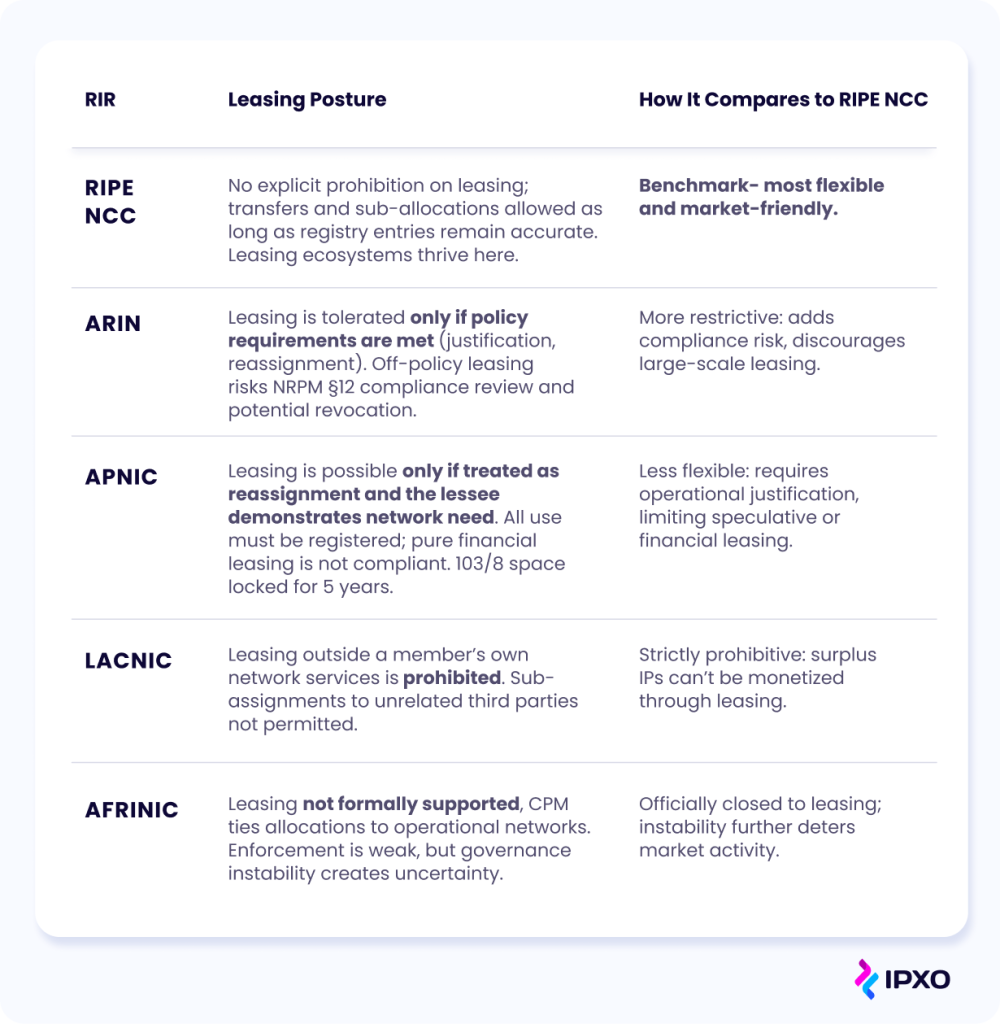
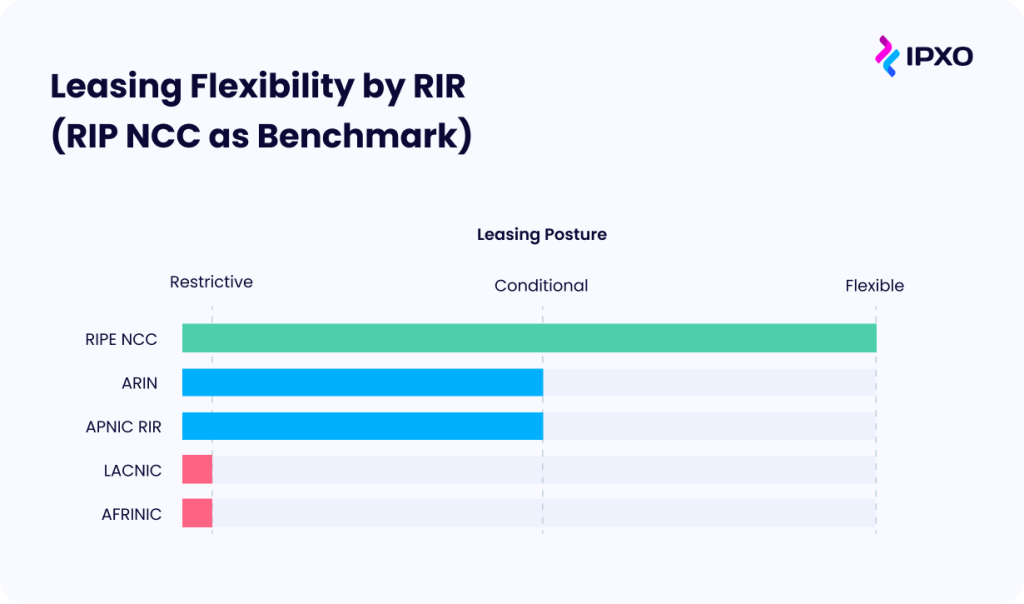
- Leasing is tolerated as long as registry records are accurate.
- Supports inter-RIR transfers (the only region actively absorbing inflows).
RIPE NCC has become the global center of IPv4 liquidity. Hyperscalers (notably Microsoft) and brokers prefer RIPE because it combines speed, predictability, and low cost. Surplus IPs can be safely stockpiled and monetized through leasing.
Bottom Line
- RIPE NCC is the clear policy winner: it combines flexibility, cost efficiency, and inter-RIR connectivity.
- APNIC sits in the middle- functional but limited by fee structure and 103/8 restrictions.
- ARIN is stuck between legacy dominance and modern policy friction.
- LACNIC and AFRINIC are the losers: restrictive or unstable policies make them unattractive for growth, leasing, or future-proof strategies.
Fee Models: The Hidden Incentive Structure
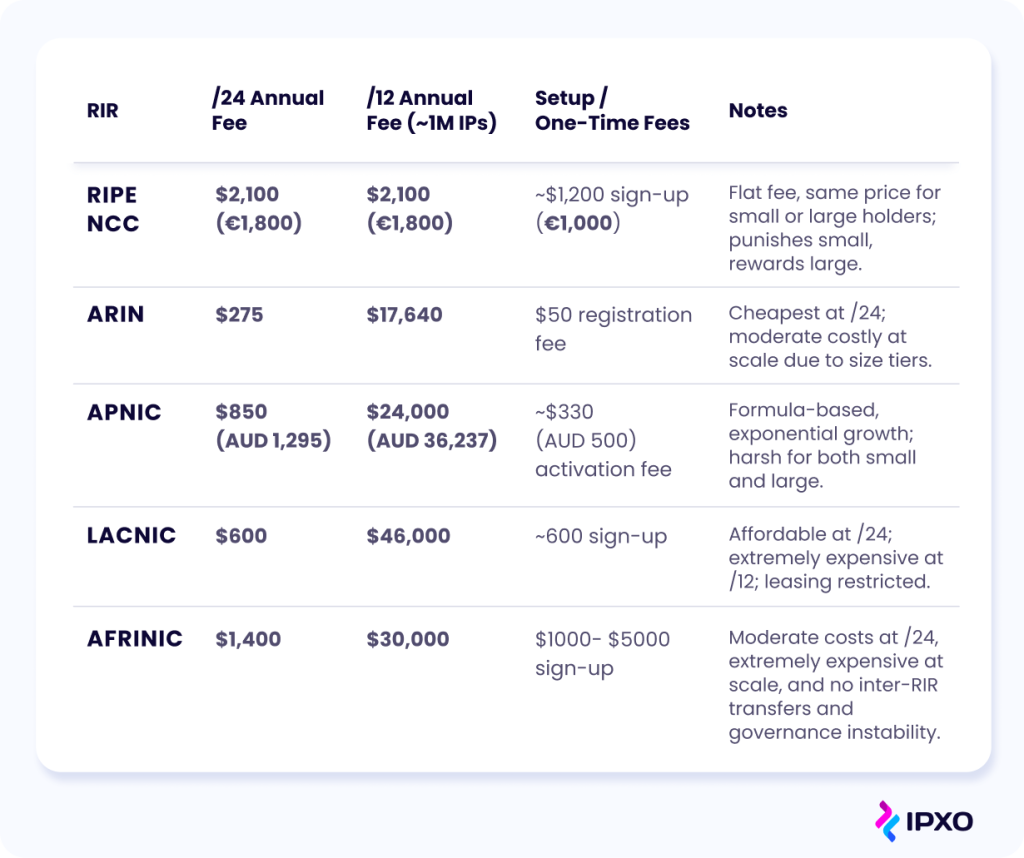
Annual membership fees are not just paperwork; they are market-shaping incentives. The cost of holding IPv4 addresses varies drastically by RIR, and those differences push large holders to consolidate in some regions while leaking out of others.
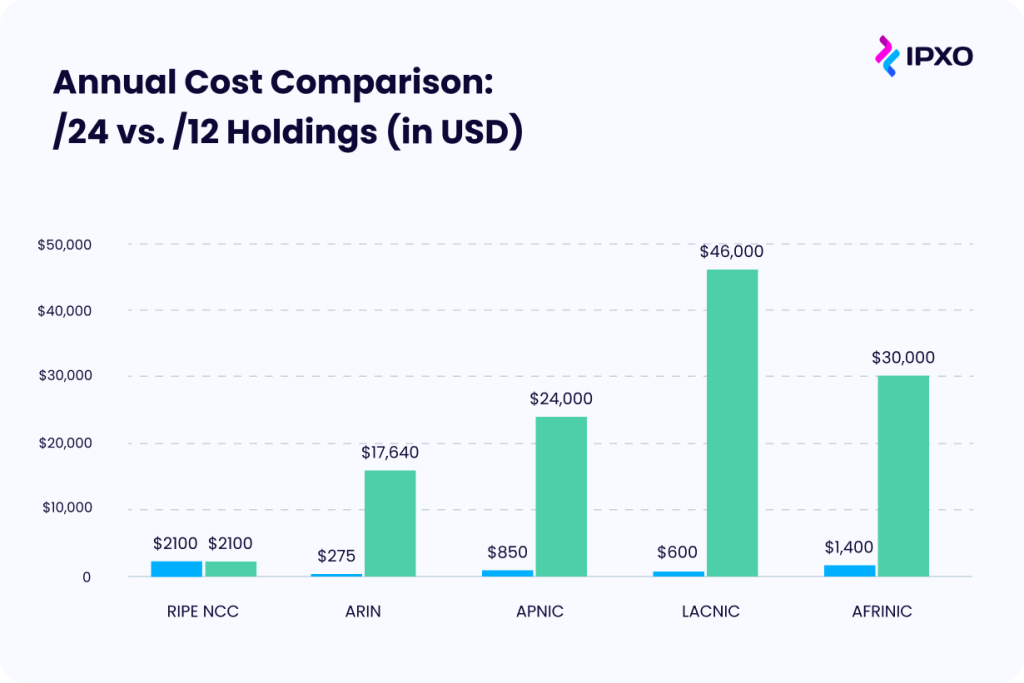
Annual Cost Comparison: /24 vs. /12 Holdings (in USD)
Key Takeaways
- RIPE NCC: Penalizes small holders, but a paradise for large holders (flat fee).
- ARIN & APNIC: Both are cheap for /24s, but expensive at /12 scale.
- LACNIC: Cheap at /24, brutally expensive at /12, plus restrictive leasing.
- AFRINIC: Moderate at /24 and expensive at /12, and governance chaos and no inter-RIR transfers ruin it completely.
Leasing Posture Across the RIRs (Compared to RIPE NCC)
Business Cases: How Policy Shapes Real-World Strategy
Policies are not just governance documents; they directly affect how telcos, hyperscalers, and enterprises scale their networks.
Here are concrete scenarios:
Telco Expanding Capacity in RIPE vs. ARIN
- RIPE NCC: A telco can acquire or lease large blocks without justifying need, paying a flat $2,100 (€1800) annual fee regardless of size. Holding surplus is cheap, and leasing dormant IPs via a marketplace (like IPXO) is fully viable.
- ARIN: The same telco faces size-based annual fees (tens of thousands at scale) plus strict needs justification. Surplus cannot be easily retained or leased, as ARIN could flag it in a policy review.
Result: RIPE encourages stockpiling + leasing; ARIN discourages it.
Infrastructure Provider with Surplus Holdings
- APNIC: Surplus addresses are expensive to hold due to size-based fees, but can be pre-approved for future use. Leasing is possible only to a downstream customer demonstrating a network need, limiting speculative leasing.
- LACNIC: Surplus holdings become a liability because leasing is effectively prohibited. Dormant addresses can’t generate revenue, pushing holders to sell or exit the RIR.
Result: Holders in APNIC may cautiously lease; in LACNIC, surplus is dead capital.
AFRINIC: A Dead Market for IPv4
Unlike the other RIRs, AFRINIC is not simply restrictive- it is effectively non-functional as a marketplace for IPv4.
Why?
- No Inter-RIR Transfers: AFRINIC is the only RIR that does not allow resources to move in or out. This makes it completely isolated from the global IPv4 economy.
- Governance Crisis: Years of lawsuits, board suspensions, and internal disputes have paralyzed policy development and eroded trust in the registry.
- Policy Rigidity: Leasing is not formally supported; allocations must be justified for operational networks. Dormant holdings cannot be monetized.
- Economic Irrelevance: Even with moderate fee tiers (~$25k–$30k for 1M IPs), large holders avoid AFRINIC because resources are effectively “stuck” there.
AFRINIC is a dead end for both buyers and sellers. No hyperscaler, telco, or enterprise considers AFRINIC a viable region for acquisitions or leasing, and any addresses there are treated as stranded assets.
Hyperscaler Acquisition Strategy (ARIN Legacy vs. RIPE Liquidity)
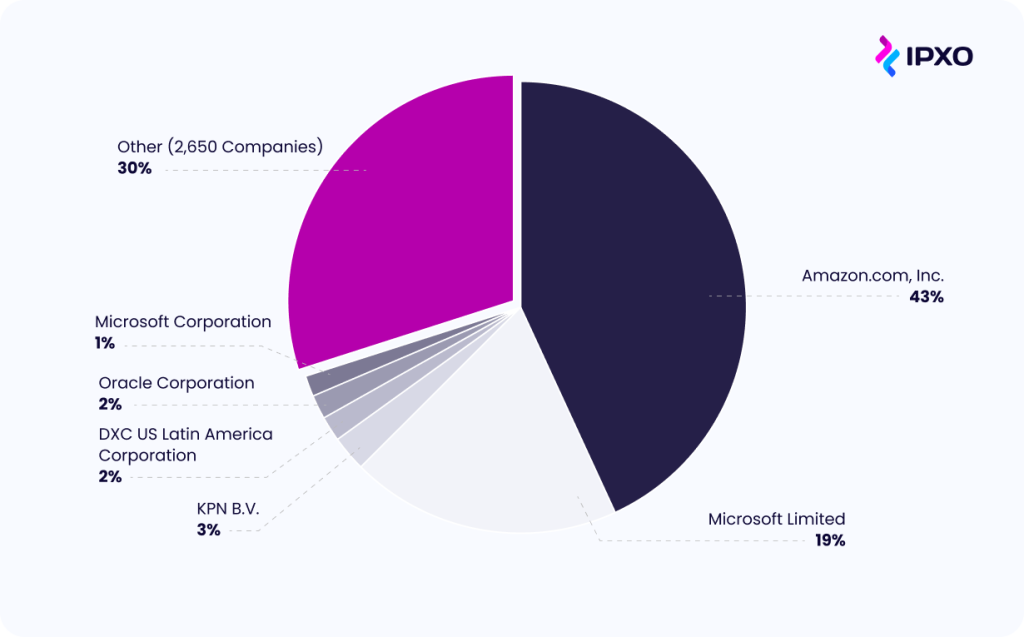
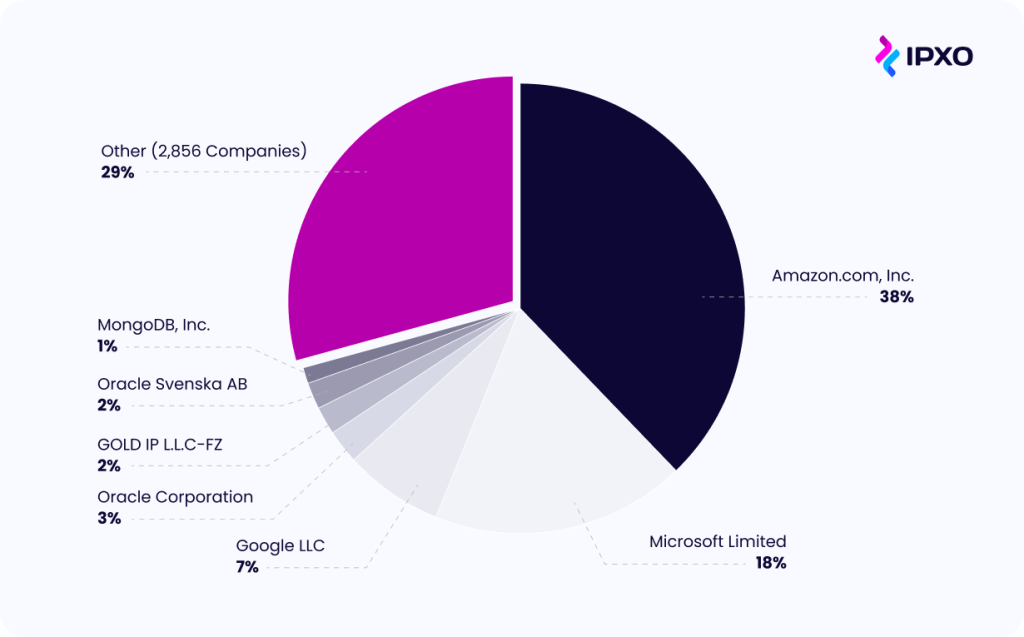
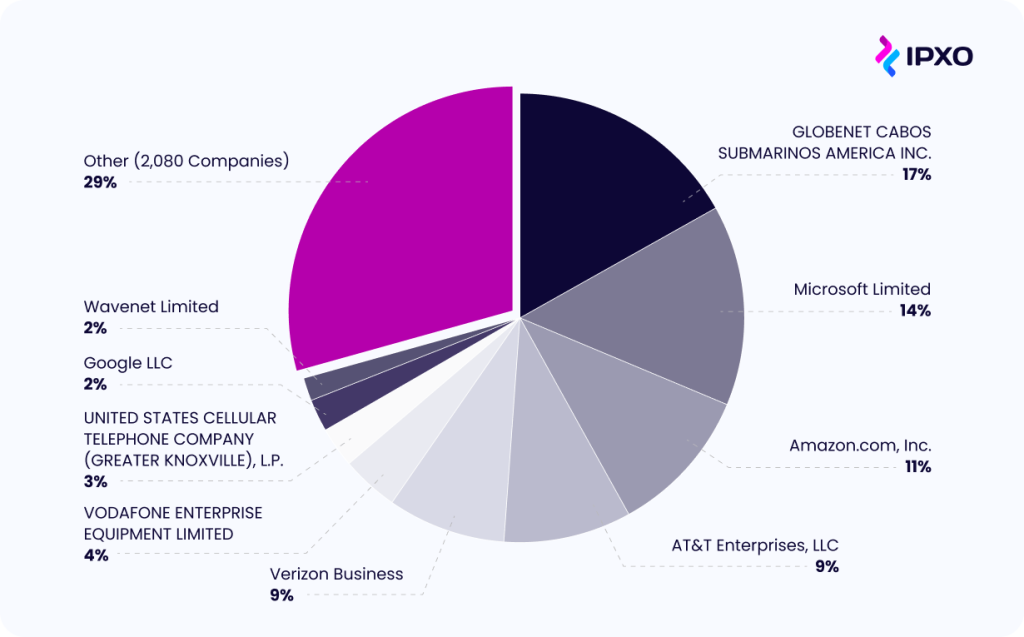
- ARIN: AWS, Google, Meta, and others hold most IPv4 resources here. Much of this space originates from legacy blocks in North America that were acquired later via transfers, mergers, or purchases from original holders. ARIN remains its primary base, even though new acquisitions are slowed by needs-based justification and higher fees.
- RIPE NCC: Microsoft, in particular, has actively used RIPE for new acquisitions. The appeal lies in RIPE’s no-justification policy, flat annual fees, and faster transfers, making it the global liquidity hub for buyers needing fresh space.
- Other RIRs (APNIC, LACNIC, AFRINIC): These regions are off the table for hyperscalers. Needs-based justification (APNIC, LACNIC), leasing restrictions, high costs, and, in AFRINIC’s case, governance instability and no inter-RIR transfers make them unattractive.
Leading IPv4 Acquirers in 2023
Leading IPv4 Acquirers in 2024
Leading IPv4 Acquirers in 2025
Where the Addresses Flow: 2023–2025 Trends
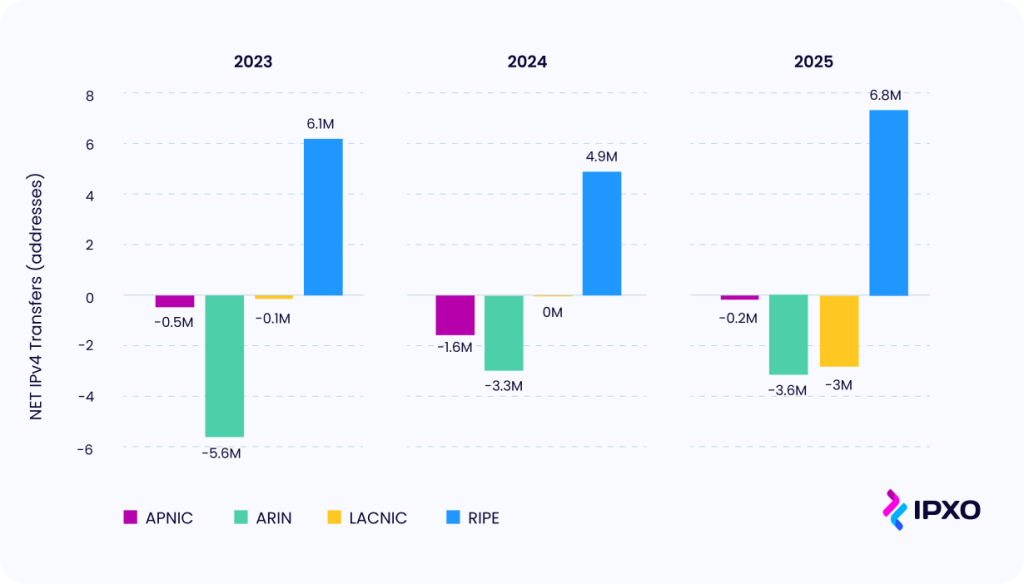
The past three years of transfer activity reveal a clear pattern: some RIRs steadily gain, while others leak supply into the market. The flow of IPv4 is not random – it follows policy flexibility, fee structures, and transfer rules.
2023: RIPE as the Net Gainer
- RIPE NCC absorbed a net +6.1M IPv4s, reinforcing its role as the global liquidity hub.
- ARIN leaked –5.6M, while APNIC (–507k) and LACNIC (–7k) saw more minor losses.
Flat fees and no justification made RIPE the natural destination for addresses leaving stricter regions.
2024: Consolidation Continues
- RIPE NCC gained another +4.9M.
- ARIN (–3.3M) and APNIC (–1.6M) continued to leak.
- LACNIC remained largely neutral (–1k).
With no policy shifts, existing incentives drove more space from restrictive RIRs toward RIPE.
2025: A Dramatic Shift in LACNIC
- RIPE NCC registered its most significant recent gain, +6.8M.
- LACNIC flipped into a prominent net leaker at –3M, the steepest single-year outflow on record.
- ARIN recorded a net outflow of 3.6M IPv4 addresses, while APNIC leaked modestly (–190k).
LACNIC’s prohibition on leasing and stricter justification rules turned surplus holdings into liabilities, pushing members to exit.
Implications
- RIPE is the only consistent gainer – because it offers predictability, speed, and low cost.
- ARIN and APNIC are systematic leakers, constrained by needs-based justification and size-based fees.
- LACNIC’s collapse in 2025 shows how rigid policy can backfire, triggering large-scale outflows.
- AFRINIC remains invisible in these statistics – no inter-RIR transfers are permitted, effectively cutting it off from the global market.
Technological Capabilities Across the RIRs
While all RIRs share the same core functions- resource registration, WHOIS services, and policy coordination – their technological maturity and service offerings vary widely. These differences influence how valuable members perceive their fees to be, and how well the registries can adapt to the demands of modern networks.
RIPE NCC
- Strengths: Operates one of the most advanced and user-friendly platforms. The RIPE Database is highly automated and integrated with RPKI, IRR, and abuse contact validation tools. Offers APIs that many operators actively use for automation.
- Gaps: Despite its leadership, RIPE tools can feel fragmented, with some legacy systems still in place. Harmonization across services (WHOIS, IRR, RPKI) could be improved.
ARIN
- Strengths: ARIN Online provides a relatively mature interface for resource management. Strong compliance tooling and integration with RPKI have been priorities in recent years.
- Gaps: APIs exist but are less flexible compared to RIPE.
APNIC
- Strengths: Invests actively in training and outreach, with some innovative measurement projects (APNIC Labs). RPKI support is strong, and its MyAPNIC portal provides a solid base for members.
- Gaps: The fee model is modern, but the registry software feels less unified. Automation could be improved, and cross-registry interoperability remains limited.
LACNIC
- Strengths: It has developed critical services like MiLACNIC for member management, was the first RIR to provide RPKI management, and has reallocated resources to other organizations. It is also known for stability and regional training efforts.
- Gaps: Less WHOIS automation and API flexibility compared to RIPE and APNIC. Interoperability with other RIRs is minimal, and adoption of advanced tooling has been slower.
AFRINIC
- Strengths: It provides basic WHOIS and RPKI services and has invested in regional training and capacity building.
- Gaps: Technological progress has been severely hampered by governance and legal crises. Tooling is fragmented, automation is minimal, and systems often lag behind global standards. AFRINIC is the least advanced of all RIRs in terms of technical capability.
Red Flags & Tipping Points: What could break the RIR model
Transfer statistics make one reality clear: RIPE NCC is consistently a net gainer, while ARIN, APNIC, and now LACNIC leak supply year after year. At first glance, this looks like a simple redistribution – but when we look at the financial structures of the RIRs, we see deeper sustainability risks emerging.
Revenue Models Under Pressure
Each RIR funds its operations through annual fees, but their fee models differ dramatically:
- RIPE NCC relies on a flat annual fee of $2,100 (€1,800) per member.
- ARIN, APNIC, LACNIC, and AFRINIC charge size-based fees, meaning a small group of large holders provides a disproportionate revenue share.
This design creates very different risk profiles. For RIPE, the danger lies in membership erosion (fewer LIRs paying flat dues). For the others, the risk is large-holder attrition (big payers exiting, shrinking, or leaking to RIPE).
Stress-Testing the Numbers
Based on publicly available audited reports, here is an approximate picture of each registry’s financial resilience:
- RIPE NCC: ~$41.9M (35.7M €). With fees around $2,100 (1,800 €) per member, the break-even point is 23,000–25,000 members. Every 1,000-member drop equals $2.1M (1.8M €). If younger networks stop joining and consolidations accelerate, RIPE could face downward pressure despite being the fastest-growing registry.
- ARIN: $28.9M. Its largest holders pay $64k–$100k each. If just 20% of these top-tier members exit or reduce holdings, ARIN could lose $3M – over 10% of the budget – in a single cycle. While community-driven, compliance reviews, and needs-based justification add friction that could accelerate attrition risk.
- APNIC: $31.7M. Large holders (/11 or bigger) pay $27k (47,833 AUD) or more each, which accounts for a large share of the budget. If only 10–15% of them shift resources to RIPE, APNIC could see $2–3M in revenue evaporate.
- LACNIC: $10.8M. Larger LIRs pay $40k–$250k each (with Telefonica Brasil being the only LIR in the top fee tier). Because inter-RIR leasing is prohibited, surplus addresses often become dead capital. If just two or three major telcos exit in one year, LACNIC could face a ~$0.5M gap- significant against its smaller baseline.
- AFRINIC: $5.46M (2021, last audited report). Without inter-RIR transfers and ongoing governance crises, even modest attrition or delayed payments from prominent members can put its financial stability at risk.
Financial Shock Thresholds
Using the most recent audited financials available (2024 for ARIN, RIPE NCC, APNIC, LACNIC; 2021 for AFRINIC) and the total allocated IPv4 space in each region, we can also model the impact of shocks as both financial losses and equivalent IP outflows:
ARIN: ~$28.9M.
10% shock = ~$2.89M → ~165M IPs
20% shock = ~$5.78M → ~330M IPs
RIPE NCC: ~$41.9M (35.7M €).
10% shock = ~$4.19M → ~85M IPs
20% shock = ~$8.37M → ~170M IPs
APNIC: ~$31.7M.
10% shock = ~$3.17M → ~89M IPs
20% shock = ~$6.34M → ~178M IPs
LACNIC: ~$10.8M.
10% shock = ~$1.08M → ~18M IPs
20% shock = ~$2.16M → ~37M IPs
AFRINIC: ~$5.46M (2021, last audited report).
10% shock = ~$0.55M → ~12M IPs
20% shock = ~$1.09M → ~23M IPs
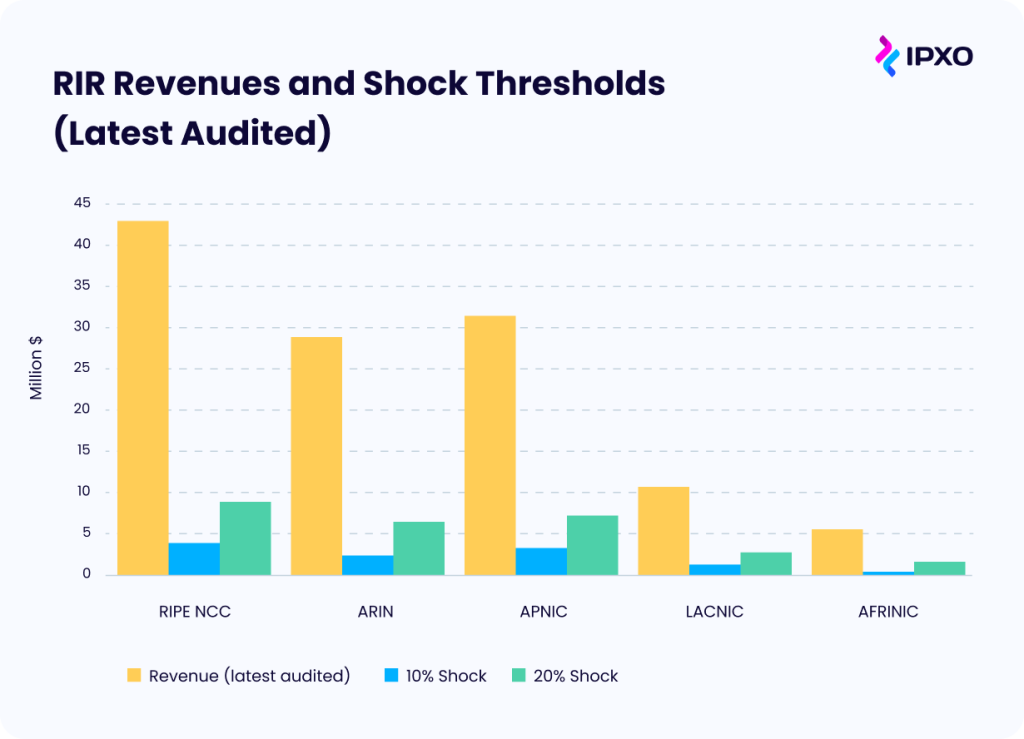
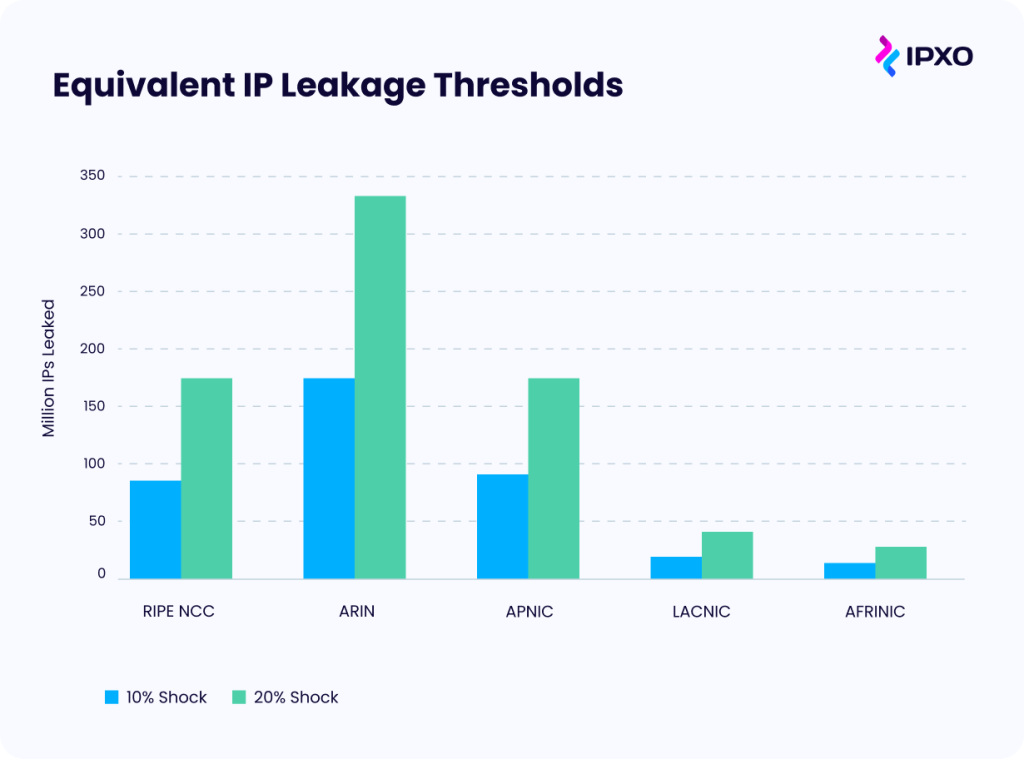
It’s important to stress that these IP loss figures are proportional simplifications. In practice, the impact depends heavily on the fee scheme in each RIR. Within regions like ARIN or APNIC, fees scale with the number of IP addresses an LIR holds, so losing a large LIR could be disproportionately damaging. By contrast, in flat-fee systems, shocks are more evenly distributed across members.
This analysis underlines two systemic risks:
- Financial fragility: Smaller RIRs like AFRINIC and LACNIC have lower revenues than ARIN, APNIC, or RIPE NCC. Even modest member attrition could destabilize their budgets.
- Concentration risk: In usage-based fee schemes, the registry’s health may depend on just a handful of large LIRs. Their exit could trigger sudden, outsized financial shocks.
Together, these findings suggest that while the Internet registry system appears stable on the surface, it may rest on fragile foundations – susceptible to proportional member losses and the financial concentration of a few key players.
Beyond Budgets: Technology and Community
Financial pressure isn’t the only red flag. The RIRs also face a community renewal problem. Policy forums are aging, and attracting younger operators has proven difficult. Without new blood, bold reforms become unlikely.
Another weakness is that RIRs have historically positioned themselves as gatekeepers of resources rather than facilitators of collaboration. To remain relevant, they must bring members closer to development processes – enabling LIRs, ISPs, enterprises, and cloud operators to share best practices, build tools, and co-create standards. This shift would transform the RIR role from custodian to community enabler, creating a stronger common ground among members.
At the same time, technology expectations have moved far beyond WHOIS and RPKI. Networks demand automation, APIs, abuse-data integration, and interoperable standards across regions. Some RIRs lag behind, offering scattered or outdated tools, which makes it harder to justify rising membership costs.
The Tipping Point
The math suggests that if 10–20% of top-tier contributors in ARIN, APNIC, or LACNIC exit, or if RIPE loses 5–10% of its members, each registry could be forced to raise fees, cut services, or dip into reserves. This is not just a budget issue – it’s the beginning of a destabilizing cycle.
Here’s how the spiral unfolds:
1. Fee Pressure on Remaining Members
- Smaller members cannot fill the gap proportionally when a handful of large contributors leave.
- In ARIN, APNIC, and LACNIC, just a few dozen large holders provide 30–50% of the total revenue. If even 10–20% of them exit, the registry loses millions in annual income.
- The registry is then forced to raise fees on those who remain. However, higher costs push members to consider moving resources elsewhere, so fee hikes accelerate the problem.
2. Service Erosion
- If fee hikes are politically or operationally impossible, registries cut back: fewer staff, delayed automation projects, reduced outreach.
- The impact is immediate: ticket backlogs grow, registry systems lag behind modern network needs, and members begin to see less value for the money they already pay.
- Once service quality dips, member trust erodes- and with it, their willingness to maintain membership.
3. Policy and Reputation Risk
- Across all RIRs, making policy changes that reflect modern realities or broadening the vision to match today’s market environment has become increasingly complex. Even well-intentioned proposals often stall or dilute because the processes are slow, consensus-driven, and rooted in older interpretations of “need” and “fairness.”
- The challenge is amplified by the fact that the active policy community is aging. Most RIR mailing lists have the same names and perspectives, which have been recurring for years. While this consistency demonstrates dedication, it creates an echo chamber where new voices and ideas struggle to gain traction.
- The result is that many policy discussions circle back to established positions rather than progressing toward meaningful reform. For members seeking agility and innovation, this reinforces the perception that the system is unable- or unwilling- to adapt.
The Feedback Loop
Less revenue → higher fees or weaker services
When income drops due to outflows or member attrition, the registry has only two immediate levers: increase fees or reduce costs. Both are painful choices. Raising fees burdens those who remain, while cutting costs often undermines the services (automation, compliance, security tools) that members rely on.
Higher fees or weaker services → fewer members
Members constantly weigh the cost of staying against the value they receive. If fees rise sharply, or if services feel outdated and slow compared to what modern networks expect, some members will decide that the registry contract is no longer worth it. Larger holders, who pay the most, are the first to calculate whether shifting resources elsewhere- particularly into RIPE, where costs are flat and leasing is possible- makes better sense.
Fewer members → even less revenue
As members leave, the revenue gap widens further. Each lost member removes $2,100 (€1800) from the budget in flat-fee systems like RIPE. In size-based systems like ARIN, APNIC, or LACNIC, the departure of just a handful of top-tier contributors can wipe out millions. Each departure increases pressure on the remaining members, who, in turn, feel more exposed.
The classic tipping point
This cycle is dangerous because it accelerates itself. Less revenue leads to higher fees or weaker services, which drives more members out and causes further revenue loss. Once a registry begins this downward spiral, recovery is extremely difficult. Unlike commercial businesses, RIRs cannot quickly pivot into new revenue streams or reinvent themselves. Their mandate is narrowly tied to resource stewardship. That means their survival depends entirely on maintaining member trust, perceived value, and inclusivity in policy processes. If these break down, financial decline can quickly turn into systemic collapse.
The Path Forward: Building Sustainable RIRs
The solution is not just a matter of adjusting fee structures. Financial models are essential, but they cannot secure sustainability independently. To thrive in the long run, RIRs must evolve into platforms that deliver real value to their members in today’s internet environment.
Deliver modern, interoperable technologies
Registries need to move beyond the basics of WHOIS and RPKI. Members expect unified APIs that seamlessly transfer, reassign, and perform compliance checks across regions. Adding extended RPKI features, such as signed assertions for geolocation and reputation, would give networks stronger tools to prove legitimate use of IP addresses. This modern tooling would also make leasing arrangements (where permitted) more transparent and less prone to abuse.
Standardize compliance and automation across regions
Today, each RIR has its own processes, formats, and expectations. For global operators working across multiple regions, this patchwork creates unnecessary friction. Standardizing processes for KYC, reassignment, abuse contact verification, and transfer audits would significantly reduce operational overhead and make the registry system feel more coherent. A more consistent experience would also help prevent policy arbitrage- where members strategically shift to whichever region offers the least resistance.
Invest in community renewal programs
Policy forums remain dominated by long-standing participants, many of whom have valuable experience but represent an aging community. As a result, legacy views of the internet and its governance persist, misaligned with today’s realities and challenges. To stay relevant, RIRs must actively bring in new voices: younger network engineers, cloud providers, SaaS operators, and even developers from the open-source ecosystem. Fellowships, mentorships, hackathons, and grants for registry tooling could attract new participants who will shape the future of internet governance. Without renewal, policy inertia will only deepen.
Build open-source registry stacks
Maintaining multiple, divergent software platforms across five registries is costly and inefficient. RIRs could cut costs, increase transparency, and accelerate innovation by pooling resources and investing in an open-source registry stack. Open development would also allow members to contribute features directly, ensuring that the software evolves in line with operational realities rather than abstract policy debates.
Together, these steps would reposition the RIRs from being seen as gatekeepers of scarce resources to becoming trusted enablers of a modern internet ecosystem. Sustainability will not come from holding on tightly to the past but from aligning with the technologies, practices, and communities that define the internet’s future.
FAQ
RIPE offers no needs-based justification, has a flat annual fee, and allows inter-RIR transfers. This makes it attractive for hyperscalers, brokers, and enterprises that want predictable, low-cost access to IPv4.
About the author

Vincentas Grinius
Co-Founder
Related reading

What the EU AI Act actually means for companies building and using AI
A practical, up-to-date guide - why the law exists, where it stands after the 2026 Digital Omnibus, and the single distinction that decides how much it affects you.
Read more
National Internet Registries: gatekeeper or enabler?
A data-led look at CNNIC, IRINN, JPNIC, and the rest of the world's national IP address registries, what they were built to do, and where they now stand between…
Read more
The Internet no longer needs permission
I was in Arlington, Texas, sitting through another ARIN meeting, and for a moment, I felt like I was back in university. A large room.…
Read more
Subscribe to the IPXO email and don’t miss any news!