Table of contents
Unlock your business's full potential
Try Next-Gen IPAM for freeOpinion: Why Universities Should Monetize Their IP Addresses Instead of Selling
Explore how academic institutions can transform legacy IPv4 allocations from one-time sales into perpetual revenue streams while preserving digital heritage.

Quick Learnings:
- University IPv4 addresses are financial assets and historical heritage, as many prestigious institutions hold blocks from the internet’s early years.
- IP address leasing generates ongoing revenue streams exceeding one-time sales in about 6 years, maintaining ownership and control.
- IPv6 adoption remains slow despite its technical advantages, keeping IPv4 addresses valuable for decades and increasing the importance of strategic retention through leasing.
During the Internet’s early years, academic institutions received generous allocations of IP addresses. As a result, universities today possess an unexpectedly valuable asset class – IPv4 addresses. These digital resources have evolved from mere administrative utilities into strategic financial assets worth billions collectively.
And yet, decades later, many of these IP blocks are still held by academic institutions – quietly powering campuses, research networks, or simply lying dormant, underutilized, and hidden from public awareness.
An interesting webinar I hosted last year with the internet pioneer and innovator Steve Crocker, “IPXO Webinar | Evolving standards for Internet Registration Data: Challenges and Opportunities,” outlines the significance of internet growth and sustainability, highlighting these often-overlooked digital assets.
As IPv4 scarcity intensifies and market prices continue climbing, many academic institutions face mounting pressure to liquidate these assets for immediate financial gain.
This pressure has already yielded results. MIT, which once controlled the entire 18.0.0.0/8 block containing over 16 million addresses, sold half its allocation to Amazon Web Services in 2017. USC similarly transferred its 128.125.0.0/16 block to Amazon. These transactions represent a growing trend of universities converting digital infrastructure into one-time financial windfalls.
However, this approach may not fully grasp the nature of these assets and their potential for long-term value. Instead of considering permanent transfers, universities could benefit from embracing IPv4 monetization through leasing, thereby generating sustainable revenue streams while preserving ownership of their digital heritage.
Historical Context and the Digital Legacy of Academic Networks

When we consider the architects of the early internet, universities stand prominently alongside research labs and defence agencies. IPv4 addresses were initially distributed during the rapid expansion of the internet in the late 1980s and early 1990s, when universities were at the forefront of internet research and implementation.
This early involvement led to substantial allocations of IPv4 blocks to academic institutions, classified primarily based on institutional size and networking needs:
- Class A blocks (/8): These contained approximately 16 million IP addresses each and were allocated to large, pioneering institutions such as MIT (18.0.0.0/8) and Stanford University (36.0.0.0/8).
- Class B blocks (/16): Consisting of about 65,536 addresses each, these blocks were common among mid-to-large institutions, often with multiple blocks allocated per institution.
- Class C blocks (/24): These smaller blocks, containing 256 addresses each, were distributed to individual departments, colleges, or smaller universities.
Today, some of the world’s most prestigious universities control substantial IPv4 resources:
- MIT (Massachusetts Institute of Technology) holds part of the 18.0.0.0/8 block – originally over 16 million addresses
- Harvard University maintains the 128.103.0.0/16 block
- Carnegie Mellon University holds 128.2.0.0/16
- UC Berkeley operates the 128.32.0.0/16 block
- University of Illinois holds 128.174.0.0/16
- Princeton University owns 128.112.0.0/16
These institutions were not just consumers of internet resources – they were core contributors to its architecture, resilience, and growth. Their networks formed the backbone of global academic collaboration through initiatives like Internet2, regional research and education networks (RENs), and cross-border science infrastructure.
The False Promise of One-Time Sales
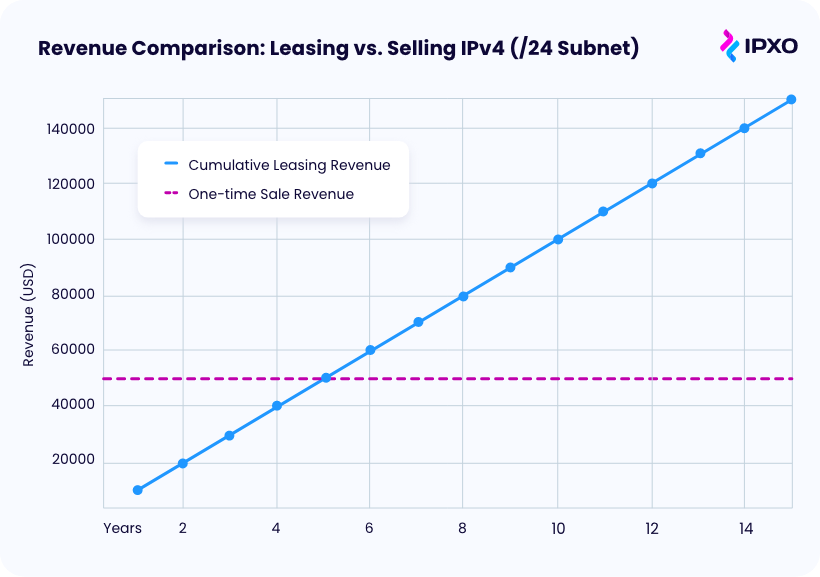
Selling IPv4 addresses might appear financially attractive in the short term. Current market rates value each IPv4 address between $45-55, creating the potential for multi-million dollar transactions, particularly for institutions holding /16 blocks (65,536 addresses) or larger.
However, this short-term approach may compromise long-term strategic flexibility and sustainable revenue generation. Once these digital assets are sold, they are permanently removed – an irreversible choice that may appear sensible in the moment, yet could be deemed shortsighted when considering the decades-long mission of academic institutions.
The CAIDA research center’s study “Sublet Your Subnet” demonstrates the compelling alternative: monetization through leasing. This approach generates continuous revenue streams rather than one-time payments, transforming static assets into perpetual funding sources for academic initiatives.
The Compelling Case for IPv4 Monetization
The strategic advantages of leasing over selling are substantial and multifaceted:
- Long-term financial returns. IP leasing creates recurring revenue streams that ultimately exceed one-time sales proceeds.
- Retained ownership and control. Universities maintain ultimate ownership of their address blocks, preserving flexibility to reclaim addresses for future institutional needs or emerging technologies.
- Simplified management through automation. Modern IP leasing platforms like IPXO have eliminated traditional barriers to IPv4 monetization through comprehensive automation. These systems handle the complex ecosystem of contracts, routing, compliance, and abuse monitoring that once made leasing impractical at scale.
- Preparation for the prolonged IPv4/IPv6 transition. Despite early predictions, IPv6 adoption continues to progress slowly due to significant technical and economic barriers. IPv4 addresses will remain valuable and necessary for decades to come, making their retention strategically important.

The reasons are multifaceted: from the high cost of upgrading legacy systems and the lack of immediate ROI, to inconsistent support from service providers and application ecosystems. Academic institutions, in particular, often lack the budgetary or operational flexibility to overhaul deeply embedded IPv4-based infrastructure.
These challenges were explored in depth during the recent IPXO webinar, “IPv6: The Future is Here – But Why Are We Still Stuck in the Past?”, where experts from Telus, RIPE NCC, and AMS-IX highlighted why IPv6 still struggles to gain ground, despite being technically superior.
The persistence of IPv4 reinforces the importance of treating IPv4 as a long-term asset – one that can be responsibly monetized while institutions gradually evolve toward dual-stack or full IPv6 environments.
Preserving Digital Infrastructure for Future Innovation
Universities have always balanced immediate needs with long-term mission fulfilment. The decision to sell IPv4 addresses raises fundamental questions about digital infrastructure strategies:
- Should institutions permanently part with digital resources they helped create?
- How will future research initiatives, expanding IoT networks, and new educational technologies access increasingly scarce IPv4 resources?
- What happens when the next generation of digital projects requires public IP addressing?
Once sold, these resources will likely never return to academic control. This is particularly problematic for institutions that still operate IPv4-based systems or rely on reputation and security mechanisms tied to long-held address blocks.
A Sustainable Path Forward
Rather than permanently transferring their digital heritage, universities should leverage automated leasing platforms to transform dormant IPv4 assets into consistent revenue generators. This approach combines financial pragmatism with strategic foresight – generating ongoing funding for academic initiatives while preserving long-term control over critical digital resources.
Academic institutions, heavily reliant on existing IPv4-based infrastructures, face significant hurdles in transitioning entirely to IPv6. Consequently, IPv4 will remain strategically relevant for the foreseeable future.
Monetizing IPv4 addresses ensures institutions maintain continuous, stable revenue streams while transitioning gradually towards IPv6, avoiding operational disruption and excessive capital expenditures.
This model enables institutions to:
- Generate annual returns on their IPv4 assets
- Maintain flexibility to reclaim addresses when needed
- Contribute to internet sustainability by efficiently allocating resources
- Preserve their historical digital footprint and network identity
Conclusion
The IP addresses silently powering university networks aren’t just technical resources – they’re artifacts of academia’s pivotal role in creating the internet. By choosing monetization over selling, institutions can honor that legacy while funding the innovations that will shape our digital future.
As academic budgets face growing pressures and digital transformation accelerates, the strategic management of IPv4 assets represents a rare opportunity to transform legacy infrastructure into sustainable funding sources. The universities that recognize this potential will gain significant advantages in both financial stability and digital capability for decades to come.
FAQ
IP address leasing allows organizations to use IPv4 addresses without purchasing them outright. The original owner retains control while the lessee uses the addresses for a specified period in exchange for recurring payments. This provides flexibility for both parties and optimizes resource utilization.
About the author

Vincentas Grinius
Co-Founder
Related reading

Static vs Rotating IPs: Which Strategy Wins for Automation and Data Collection?
Guest post by IPRoyal Data collection requires a clear, well-thought-out plan, and you’ll need reliable tools to gather information successfully from modern websites. Choosing the…
Read more
What will shape internet infrastructure in 2026
As the Internet has expanded, the constraints that shape its Infrastructure have changed. It is no longer possible to provide capacity “anywhere” with ease. The…
Read more
Introducing ipv4.events: A Timeline of the IPv4 Era
The history of IPv4 is the history of the internet itself. Every milestone – from the invention of NAT to the first IPv4 exhaustion announcements…
Read more
Subscribe to the IPXO email and don’t miss any news!